Gagaku (雅楽) is one of the traditional Japanese performing arts, though it might not be as well-known as Kabuki (歌舞伎), Noh (能) and Bunraku (文楽). Ga (雅) means “elegant, refined and graceful” and Gaku (楽) means “music”. It has been regarded as music for the imperial court as opposed to Zokugaku (俗楽) which is traditional popular music. It is recognised as Jūyō-Mukei-Bunkazai (重要無形文化財 Important Intangible Cultural Property) by the Bunka-chō (文化庁 Agency for Cultural Affairs) which is a special organisation affiliated with the Monbu-Kagaku-shō (文部科学省 MEXT: Ministry of Education, Culture, Sports, Science and Technology). Gagaku is also recognised as a UNESCO Mukei-Bunka-Isan (ユネスコ無形文化遺産 Intangible Cultural Heritage of UNESCO).
A brief history of Gagaku (雅楽)
It’s believed that ceremonial music and dance were introduced to Japan from China through the Korean Peninsula as early as the 5th century. But it wasn’t until the beginning of the 8th century, Taihō Gan’nen (大宝元年 the 1st year of Taihō era), that an official agency, Gagaku-ryō (雅楽寮 Agency of Gagaku), was established to supervise the performance, instruction and training, practice of musical instruments and their maintenance for Gagaku byTaihō-Ritsuryō (大宝律令 Taihō Ritsuryō Code). By then, music and dance from China and South-east Asia were mingling with the native and traditional Japanese music and dance.
During the Heian (平安) period (794-1185), the size of Gagaku-ryō had shrunk and musicians in the imperial court and various shrines and temples took over the performance part of Gagaku. Even amongst ordinary nobility, Gagaku was performed, not as ceremonies or Buddhist memorial services but as private concerts. This trend led to the revival of
- Saibara (催馬楽 ancient Japanese folk/popular songs used in court music)
- Rōei (朗詠 chanting of classical Chinese-style and Japanese-style poems in the court) and
- Imayō (今様 popular songs of the late Heian period).
From the late Heian period to the end of the Kamakura (鎌倉) period (185-1333), Jigenin (地下人 lower-ranking courtiers not allowed into the palace hall) musicians gradually replaced Tenjōbito (殿上人 courtiers with the privilege of entering the palace hall) musicians to perform Gagaku. This may have been the beginning of professional Gagaku musicians.
However, during the Muromachi (室町) period (1336-1573), Kyōto was devastated by civil war during the Ōnin nenkan (応仁年間 1467-1477) in particular and most musicians of Gagaku left Kyōto. Many musical instruments were destroyed and dance costumes were burnt. In addition, many music scores were lost and the techniques were discontinued.
During the Edo (江戸) period (1603-1868), the Tokugawa Bakufu(徳川幕府 Tokugawa Shōgnate)encouraged the restoration of Gagaku by establishing Sanpō Gakuso(三方楽所 the three Shōgunate’s Court Music Offices)in Nara, Ōsaka and Kyōto to revive the craft. In 1642, the third Shōgun, Tokugawa Iemitsu, invited 9 musicians from the three Gakuso to Edo (江戸) to encourage Daimyō (大名 Feudal Lord) to appreciate Gagaku. In Kyōto, Tenjōbito, too, tried to resurrect Gagaku for ceremonial and Buddhist memorial services and they were successful.
At the early days of the Meiji (明治) period (1868-1912), the government invited all Gagaku musicians in the Sanpō Gakuso to its new capital, Tōkyō (東京), formerly Edo, and established an official Gagakukyoku (雅楽局 Bureau of Gagaku), which later became Kunaishō Gagakubu (宮内省雅楽部 Gagaku Department, Ministry of Imperial Household) and currently Kunaichō Shikibushoku Gakubu (宮内庁式部職楽部 Music Department, Board of Ceremonies, Imperial Household Agency), thereby unifying and preserving Gagaku as a national and traditional culture. Gagakukyoku selected scores that would standardise nation-wide Gagaku music by compiling Meiji Senteifu (明治選定譜 The Meiji Authorised Gagaku Scores).
Nowadays, some private Gagaku groups are trying to resurrect classical scores which are not in the Meiji Senteifu or to use modern musical instruments and organise concerts.
Basic Genre ofGagaku (雅楽)
There are broadly three genres of Gagaku.
The first genre is called Kuniburi-no-Utamai (国風歌舞 Indigenous Japanese songs and dance) which refers to music passed on from ancient times.
The second genre is music which came from outside of Japan. It’s divided into two kinds. One is called Tōgaku (唐楽 Tang-dynasty-derived court music) which came to Japan from the Tang dynasty in China during the Heian period. The other is called Komagaku (高麗楽 Korean-derived court music) which came from the Korean Peninsula, mainly ancient Koryǒ. It’s more classic and plain when compared toTōgaku.
The third genre is Utaimono (謡物 vocal repertoire of classical Japanese court music) such as the aforementioned songs, Saibara, Rōei and Imayō since the Heian period in contrast with Kangen (管絃 performance with only musical instruments) which is usually performed indoors and Bugaku (舞楽 performance with musical instruments and dance) which is mainly performed outdoors.
Musical Instruments in Gagaku (雅楽)
There are 8 main musical instruments in Gagaku. They are
- Sankan (三管 the three principal wind instruments),
- Sanko (三鼓 the three drums/percussion instruments) and
- Ryōgen (両絃 the two stringed instruments).
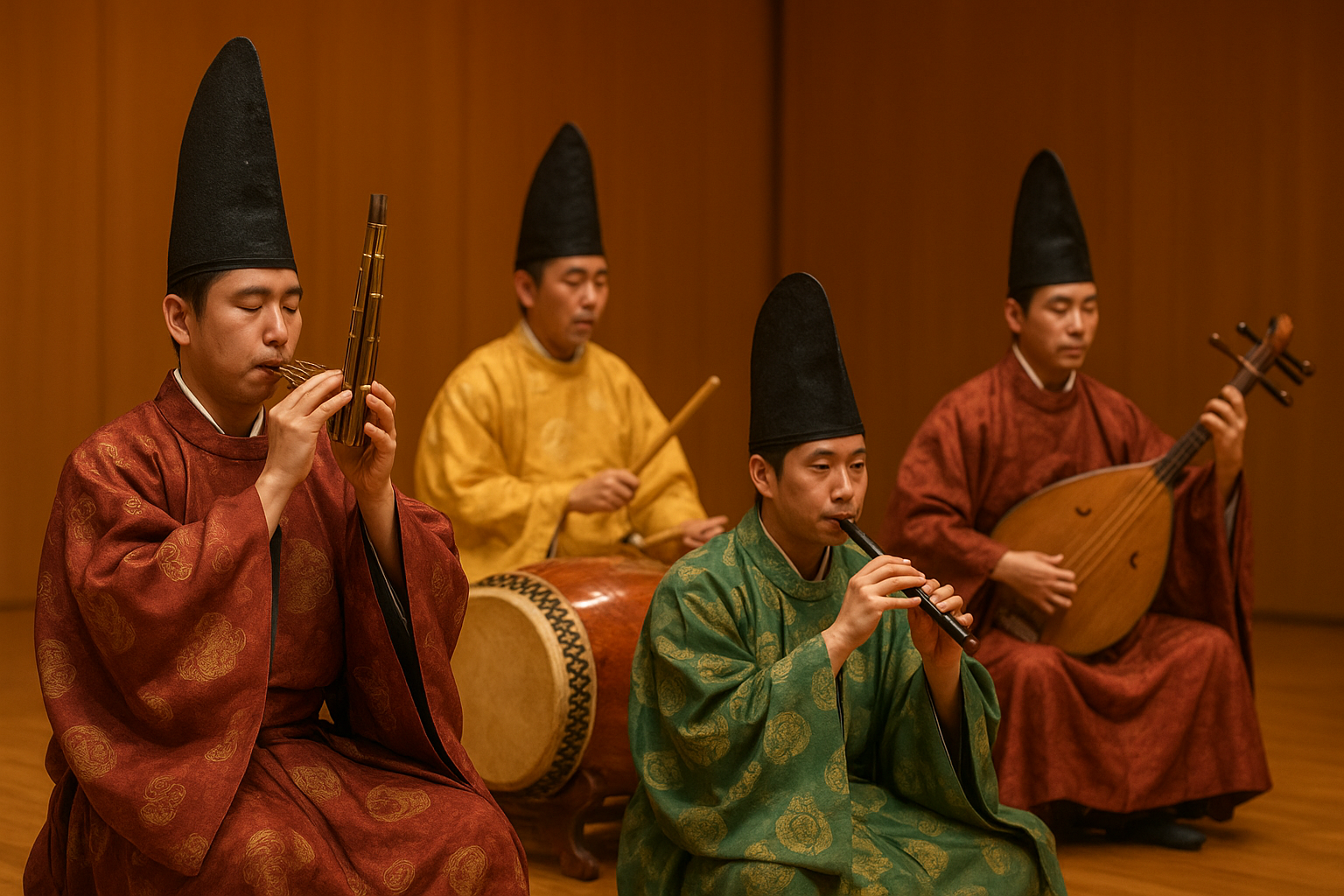
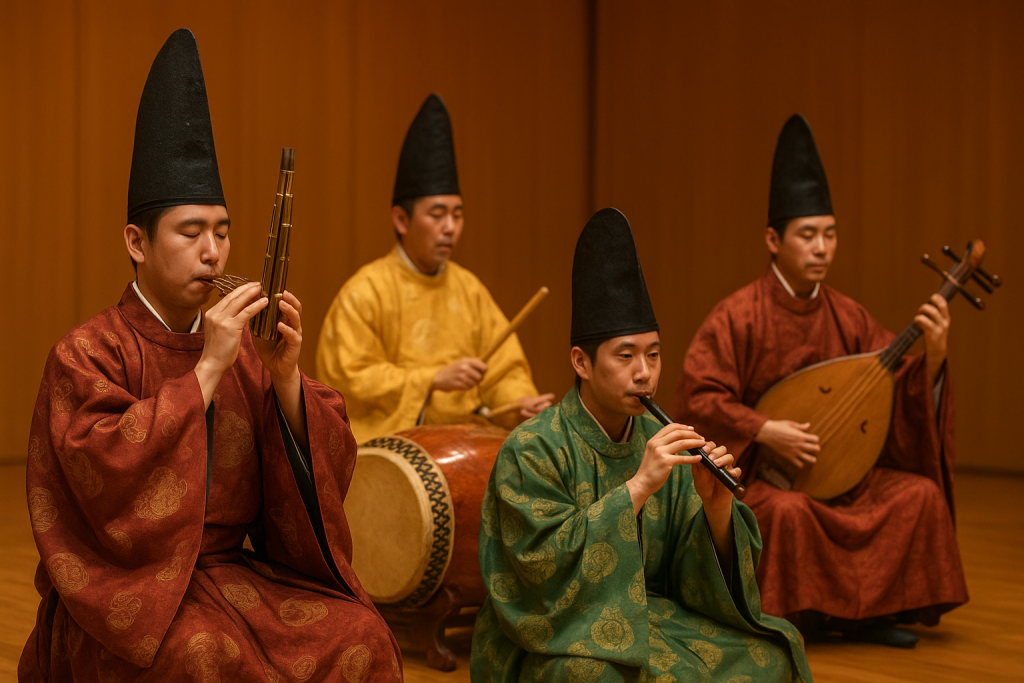
Sankan refers to Shō (笙 Shō mouth organ) or Hōshō (鳳笙 phoenix mouth organ), Hichiriki (篳篥 Hichiriki double-reed pipe) and Ryūteki (龍笛 Ryūteki transverse flute) or Ōteki (横笛 side-blown flute). The Shō symbolises the light descending from the heavens. The Ryūteki is said to depict a dragon roaming unrestrained between the heavens and the earth. The Hichiriki represents the voices of people resonating across the earth. It has been believed that when these three insturments harmonise together, it can create a universe.
Sanko refers to Gakudaiko (楽太鼓 ceremonial drum) or Ōdaiko (大太鼓 big drum), Shōko (鉦鼓 bronze gong) or Ōshōko (大鉦鼓 big bronze gong) and Kakko (鞨鼓 or 羯鼓hourglass drum) or San-no-tsuzumi (三ノ鼓 small hand drum). The drummer of the Kakko assumes the role of the conductor in western music and dictates the tempo of the music.
Ryōgen refers to the two string instruments, namely Gakubiwa (楽琵琶 court lute) and Sō (箏 zither).
Costume, Mask and Make-up
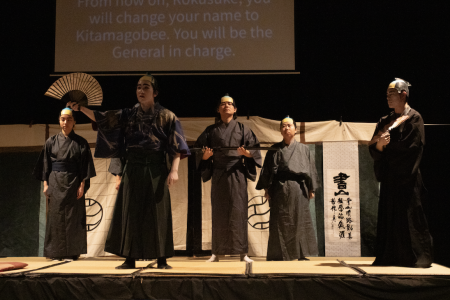
When Gakujin (楽人 musician) of Gagaku perform, they usually wear traditional costumes such as Ikan (衣冠 coat robe and cap / formal court dress) or Kariginu (狩衣 hunting robe / informal court dress) which have been court dresses since the Heian period. However, Hitatare (直垂 a formal robe worn by samurai in the medieval period) was designated as an official dress by the Gakubu since the Meiji period, not only for official Gagaku performances but also performances at shrines and temples as well as private Gagaku organisations.
For Maibito (舞人dancers), if it’s Samai (左舞 Tōgaku 唐楽 mentioned above), they wear Tang dynasty Chinese style costumes with bright colours such as red, vermilion and orange. If it’s Umai (右舞 Komagaku 高麗楽mentioned above), they wear Korean style costumes with subdued colours such as blue, green and yellow- brown. They have large sleeves which emphasise the dance movements. They also have Mo (裳 a skirt-like trailing ornament) that hangs long at the back and spreads wide when the dancer moves. In case of Kuniburi-no-Utamai and Utaimono, dancers tend to wear whitish costumes.
For some Gagaku pieces, dancers wear masks.
Opportunities to enjoy Gagaku (雅楽)
Kokuritsu Gekijō (国立劇場 the National Theatre) is trying to preserve Gagaku and has been requesting composers in and outside of Japan to compose new Gagaku pieces. They occasionally organise Gagaku concerts, too.
In addition, there are approximately 25 shrines that offer a Gagaku concert annually throughout Japan.
Author
Shunichi Ikeda
BAS Hons (ANU)
MEd (SUNY at Buffalo)
Visiting Fellow, ANU College of Asia and the Pacific