
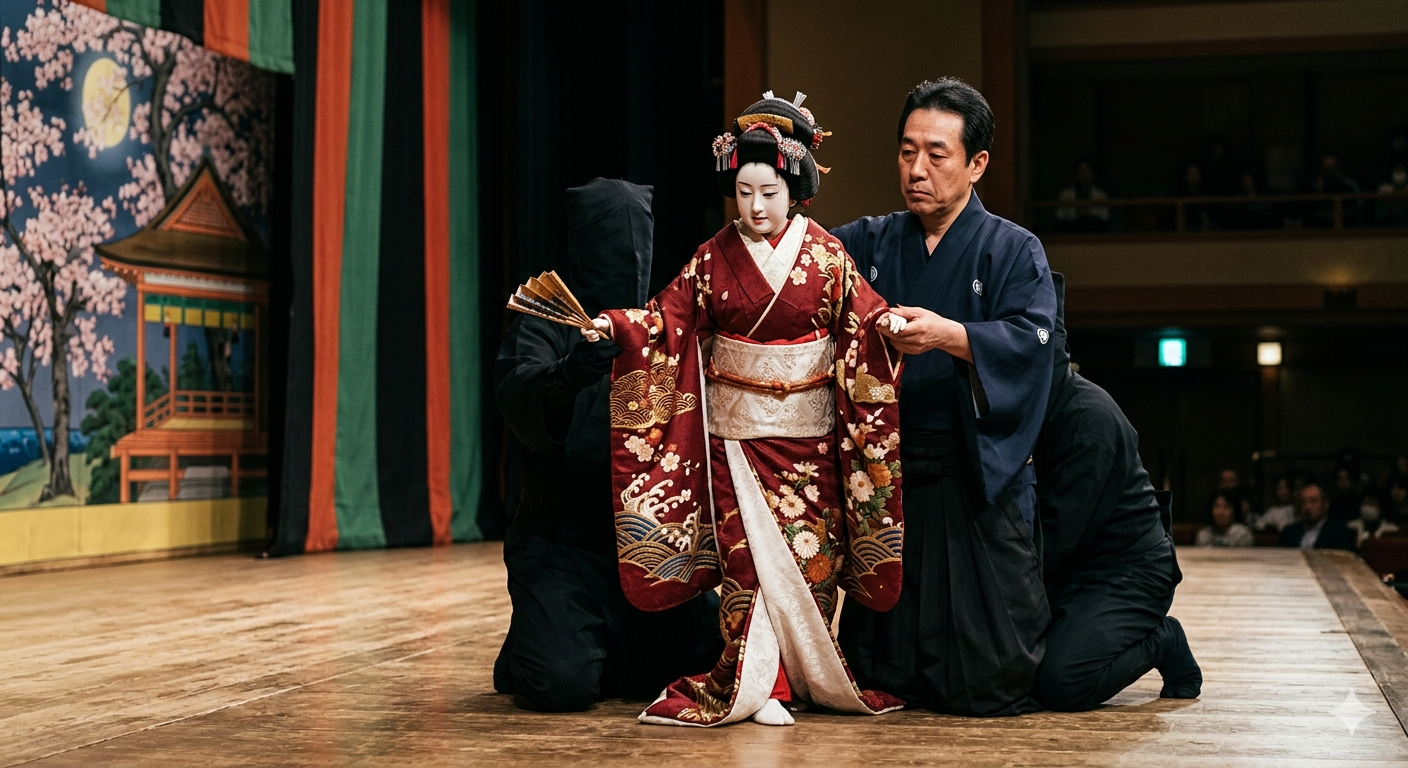
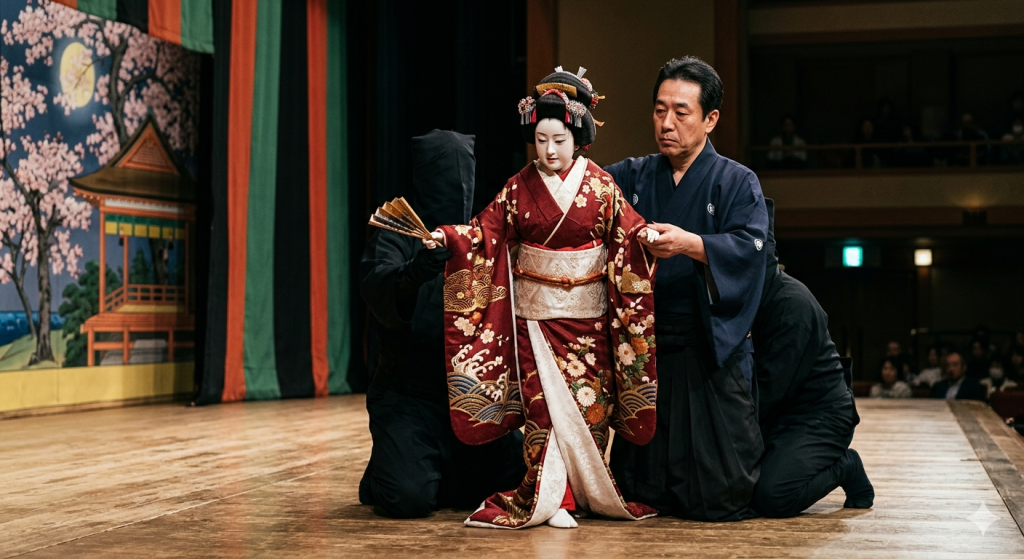
Compared to Kabuki (歌舞伎), Bunraku is a lesser known traditional performing art in the form of Japanese puppet theatre. The official proper name is Ningyō Jōruri Bunraku (人形浄瑠璃文楽) where Ningyō means puppet (generally means dolls), Jōruri is a combination of chanting and Shamisen (三味線 three-stringed musical instrument) music and Bunraku derived from a promoter’s name, Uemura Bunrakuken (植村文楽軒 1751-1810) who was originally from Awaji-shima (淡路島 Awaji Island) in the current Hyōgo-ken (兵庫県 prefecture) where Ningyō Jōruri was popular amongst the local people.
A brief history of Bunraku (文楽)
While Kabuki developed during the Edo (江戸) period (1603-1868) in Edo (currently Tōkyō), Bunraku developed during the Edo (江戸) period in Ōsaka (大阪). In 1684, Takemoto Gidayū (竹本義太夫 1651-1714), who founded Gidayū-bushi (義太夫節 a style of narrative chanting in Jōruri) by cultivating Ko-jōruri (古浄瑠璃 ancient Jōruri) into his own distinctive style, established “Takemoto-za” (竹本座 Takemoto Troupe) in Ōsaka. He started staging Ningyō Jōruri performancesby chanting Gidayū-bushi by himself. When Ningyō Jōruri became popular in Ōsaka, he trained many disciples. After a while, one of them, Toyotake Wakadayū (豊竹若太夫) started his own troupe “Toyotake-za” (豊竹座 Toyotake Troupe) and their rivalry attracted a lot of fans and Ningyō Jōruri became a common pastime for people in Ōsaka.
However, at the beginning of the Meiji (明治) period (1868-1912), there were only two troupes left, namely “Bunraku-za” (文楽座) and “Hikoroku-za” (彦六座). Subsequently, “Taketoyo-za” (竹豊座) which traced its lineage back to “Hikoroku-za” was dissolved during the Taishō (大正) period (1912-1926). Consequently, the only troupe to remain was “Bunraku-za” and it is common to call this traditional performing art as “Bunraku” which is a pronoun for Ningyō Jōruri.
In 2009, Bunraku was added to UNESCO’s Intangible Cultural Heritage list. Nowadays, Bunraku is performed mainly at the National Bunraku Theatre in Ōsaka and at the Small Theatre of the National Theatre in Tōkyō under the auspices of The Bunraku Association, a Public Interest Incorporated Foundation. Hence, compared to Kabuki that has numerous theatres throughout Japan, the opportunities to appreciate Bunraku seem to be somewhat limited because of the lack of performing theatres.
Performance by Sangyō (三業)
Three kinds of performers are required in Bunraku performance. They are the Tayū or Katari (太夫 or 語りchanters or narrators), the Ningyōtsukai or Ningyōzukai (人形遣い puppeteers) and Shamisen players/musicians. These three are called Sangyō, the three elements of Bunraku performance. In other words, Bunraku is a trinity of narration, Shamisen music and puppetry. Like Kabuki, Bunraku has been traditionally performed by males in Sangyō. However, there are some female puppeteers nowadays and the number is gradually increasing. But Tayū and Shamisen are still male only, probably from the influence of their traditional training system.
Stage design for Bunraku theatres
Normally, there is a puppetry stage in the middle of the theatre. The stage width is approximately 16-18 metres and the stage depth is approximately 10-12 metres, allowing puppets to move easily in any directions. The proscenium opening height is about 6-7 metres so the audience can observe all the puppets’ facial expressions and movements. In addition, there is a special stage for Tayū and Shamisen called Yuka (床 narration/Shamisen stage) whose width is approximately 3-4 metres, depth about 1.5-2 metres and height around 1 metre for a pair of Tayū and Shamisen player to sit on the right hand side of the main puppet stage (stage left). Yuka is equipped with a revolving platform called Bon (盆) to rotate performers when a changeover of performers on stage takes place. It used to be done by two people to rotate 180 degrees, but it’s rotated electronically now.
Tayū or Katari
As briefly mentioned above, Tayū or Katari basically narrates or chants entire stories, ranging from the description of situations to each puppet’s lines by varying their tone of voice, intonation or pitch. When the story is long, he will be replaced with another Tayū or Katari.
There are a wide range of Jōruri, but Gidayū-bushi which was founded by Takemoto Gidayū is chosen as the standard in Bunraku. The name of Tayū is pronounced as –tayū if there are 2 syllables before –tayū such as Wakatayū (若太夫), but it’s pronounced as –dayū if the number of syllables before –tayū is other than 2 such as Gidayū (義太夫)or Koshijidayū (越路太夫).
Shamisen
In Bunraku, Shamisen refers to the person who plays the Jōruri Shamisen. They use a Futozao (太棹 thick-necked) shamisen which is lower in pitch than an ordinary shamisen with a fuller tone. They sit on the floor of Yuka in seiza (正座 a formal Japanese kneeling posture) with their knees far apart so that their bottom touches the floor.
Ningyō (人形 puppetry)
The size of the puppets is somewhat smaller than the actual human beings. The average height of male puppets is approximately 100-120cm (roughly 1/2 – 2/3 of an average person) and the Samurai or the protagonist of the play is slightly taller. Children puppets are, needless to say, much smaller. Compared to male puppets, female puppets are smaller and usually 80-100cm. Their kashira (首 head) is smaller and their movements are more sensitive compared to male characters.
There are approximately 80 types of kashira and they are divided into categories according to gender, social class and personality.
Puppets’ kashira is usually made of Kiso-hinoki (木曽檜 Kiso hinoki cypress) and its movable parts such as eyebrows and eyes have some tricks. There is a thread inside that can be pulled to make the various facial expressions. A whalebone is used as a string for moving kashira.
Ningyō Costumes
Professional costume masters design and make the costumes. They are composed of a series of garments with varying colours and patterns. They include kimono (着物), juban (襦袢 underkimono), haori (羽織 short kimono jacket) and uchikake (打掛 outer robe) as well as obi (帯 kimono sash) and eri (襟 kimono collar). The costume of the puppet is taken off after each performance by the puppeteers and it is kept separately from kashira. Therefore, it is necessary for puppeteers to put on the costume when they use puppets each time which is called ningyō-koshirae (人形拵え puppet assembly). As the clothing of the puppets wear out or become dirty, they are replaced.
Ningyōtsukai (人形遣い puppeteer)
The puppeteers were originally from a very destitute background. They were called kugutsu-mawashi (傀儡廻 puppet manipulator or handler) and were treated as itinerant outcasts by upper class people of Japanese society at the time. Men operated small hand puppets and put on miniature theatre performances and women demonstrated dancing and magic tricks to attract travelers.
In its early days of Bunraku, there was only one Ningyōtsukai (人形遣い puppeteer)who manoevered one ningyō, but it is said that the three puppeteer system was devised in 1734 and it has been kept in this three-person puppeteering system in which one puppet is operated by three puppeteers.
Omozukai (主遣い chief or principal puppeteer) manipulates the head and right hand of the ningyō,Hidarizukai (左遣い left-hand puppeteer) is in charge of the left hand of the ningyō and Ashizukai (足遣い leg or foot puppeteer) manoeuvres the legs and feet of the ningyō. As its namesake, Omozukai controls the entire performance by giving signals to the other two puppeteers in a highly coordinated technique. All of them are clad in black, including a black hood to hide their faces, but Omozukai occasionally exposes his face when the story requires and it is called Dezukai (出遣い unhooded). Hidarizukai operates the ningyō’s hand using Sashigane (差金 control rod) by standing in a slightly farther position. Hidarizukai can play an assistant role of handing over some props to Omozukai and Ashizukai, because one of his hands is free. For a minor role ningyō, one puppeteer manipulates the head and right hand of the ningyō by himself.
Evolution of puppets
According to the historical record published in 1861, puppets have been improved in the following way:
- Feet were added to the body in the latter half of the 17th century.
- Fingers became movable in 1733.
- It became possible to move the eyebrows in 1741.
- It became possible to let puppets wear Katabira-ishō (帷子衣装 a lightweight/unlined summer costume) in 1745.
- More movements of puppets such as moving eyes, sticking out the tongue, making the hairs stand on end and moving the belly all became possible in 1861.
Emergence of playwrights
Like Kabuki, Bunraku became more popular with the emergence of specialised playwrights such as Chikamatsu Monzaemon (近松門左衛門 1653-1724) who was a well-known Kabuki and Bunraku playwright with more than 100 plays to his credit. In fact, both of his fiction and non-fiction stories based on actual incidents were suitable for both Bunraku and Kabuki and both popular jidaimono (時代物 history plays) and sewamono (世話物 domestic plays) were adapted from Bunraku to Kabuki and vice versa.
Following Chikamatsu Monzaemon who wrote many stories in script as literature, Kino Kaion (紀海音), who wrote more sewamono stories by himself, popularised Chikamatsu’s work as dramas in theatres. Following Kino Kaion, Takeda Izumo (竹田出雲 c.1651-1732), who was a Jōruri composer in the middle of the Edo period, made Ningyō Jōruri as a completed theatrical art and promoted the works of Chikamatsu and Kino as Bunraku in theatres.
Bunraku plays
Bunraku repertory is often divided into two categories. The first category is jidaimono (時代物 historical or pre-Sengoku (戦国) the Warring States period stories). The Shogunate authorities in the Edo period prohibited Bunraku and Kabuki productions to dramatise actual incidents to criticise the Tokugawa (徳川) regime. Hence, all stories had to be based on pre-Sengoku incidents, but needless to say, the audience knew that each story is modeled on what happened or what is happening in the Edo period. There is one exception, notably, “Kanadehon Chūshingura (仮名手本忠臣蔵 The Treasury of Loyal Retainers) which was based on an actual incident and which became so famous and spread amongst people of all social classes, the regime was unable to contain this incident, thereby allowing the production to go ahead with names of people changed in the play. This story is still by far the most popular Bunraku and Kabuki play even now. The second category is sewamono (世話物 domestic plays or domestic drama). They mainly depict incidents happening amongst ordinary townsfolks to evoke empathy from the audience. Some are comedy and others are tragedy.
Difference between Bunraku and Kabuki
A fundamental difference between Bunraku and Kabuki is that Bunraku values the script and the work of Sangyō, namely,Tayū, Ningyō-tsukai and Shamisen, whereas Kabuki focuses on the performances of the main actors. In other words, Sangyō tries to demonstrate their best presentation on stage, but at the same time they aim at representation of the original script as close as possible. Whereas in Kabuki, it allows actors to insert a play on words, ad-libs, references to contemporary incidents and other things which deviate from the script. The audience enjoys the actors’ impromptu insertions.
In Bunraku, prior to the performance, Tayū holds up the script and bows to it, vowing to follow it faithfully.
Bunraku for your next trip to Japan
If you are interested in Bunraku, why not plan ahead and make a booking of a Bunraku performance either in Ōsaka or Tōkyō.
Author
Shunichi Ikeda
BAS Hons (ANU)
MEd (SUNY at Buffalo)
Visiting Fellow, ANU College of Asia and the Pacific
There is an English version of the website above. Click the English button.
-2-1-scaled-rmd1qhd3i94shfc39j38f35b4oy1zrp28vbwdbn6m0.jpg "ウポポイブース写真(ヨコ) (2)")


-2-1-scaled-rmd1qhczl1gbsc9wcqpyertlkfgif5b7zx777g3dvk.jpg "ウポポイブース写真(ヨコ) (2)")